

For decades, enterprise software followed a simple model. Vendors built large, fixed applications. Customers changed their processes to fit. Updates came when the vendor was ready. Specialist needs waited.
That worked when change was slow. It does not work now.
Industries are more complex. Regulations shift quickly. Business models change fast. Software that cannot keep up becomes a problem.
This is where the configurator comes in.
What is a configurator?
A configurator is a domain expert who builds and manages software using a configurable platform. They might be a boutique consultancy, an independent specialist, or an in-house expert. What they share is deep knowledge of how a particular industry works. And the ability to turn that knowledge into a working system.
They are not software developers. They do not write code. They use low-code platforms to design workflows, data models, and calculation logic. The platform handles the infrastructure. The configurator handles the expertise.
Why configurators matter
Traditional vendors work on long product cycles. A new feature might take a year to design, build, and release. For teams facing fast-moving challenges, such as new emissions rules or urgent post-acquisition work, that wait is not viable.
A configurator works differently. They design and deploy a solution in weeks. Built around the client’s business logic. No vendor roadmap required.
Credibility matters too. Businesses trust people who have faced the same problems. A specialist who has managed hydrocarbon allocation for decades speaks with more authority than a product demo. Configurators bring that experience into the solution they build.
There is also a commercial shift. Traditionally, consultancy expertise was sold by the hour. Each project started from scratch. Configurators who build on platforms can turn their knowledge into repeatable solutions. A framework built for one client can be adapted for ten more. The expertise scales. The revenue does too.
How it works in practice
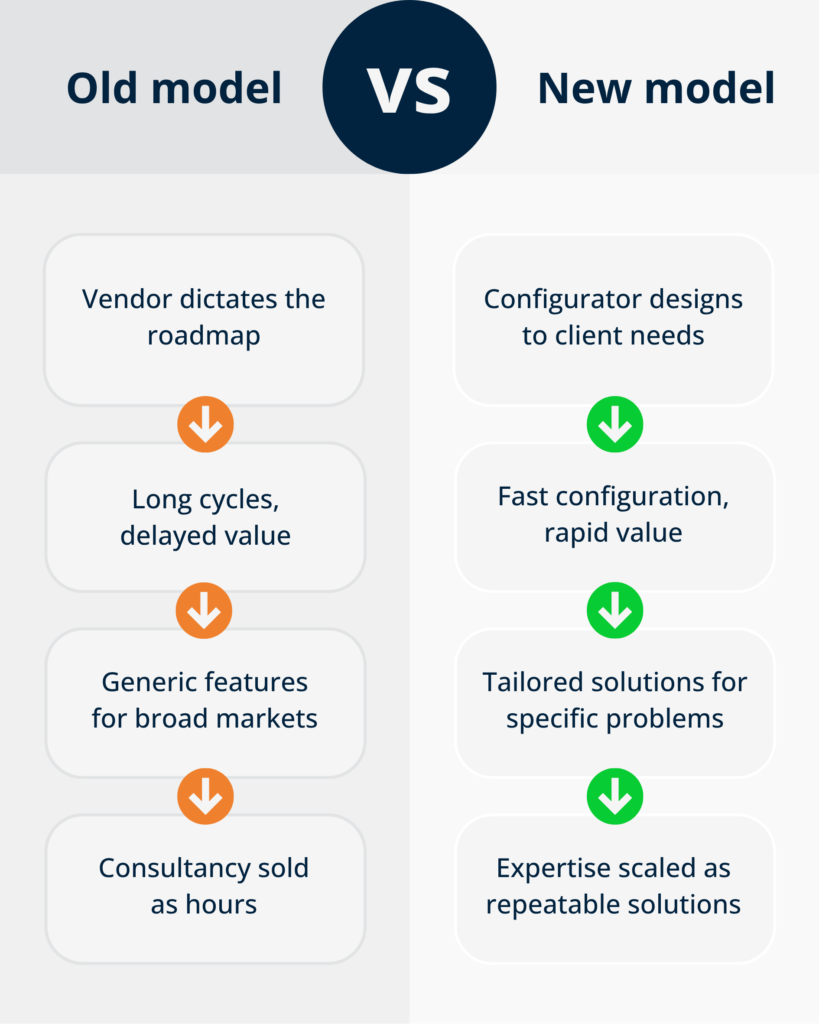
The shift is straightforward. In the old model, the vendor dictates the roadmap. Features are built for broad markets. Delivery takes a long time. Consultancy is sold as time.
In the new model, the configurator designs to the client’s needs. Solutions fit specific problems. Value arrives faster. Expertise becomes a scalable asset.
We have already seen this in energy. Specialists have used EnergySys to configure emissions tracking and hydrocarbon accounting solutions, deploying them in weeks rather than months. Their credibility came from having lived the exact challenges their clients were trying to solve.
The same pattern is emerging in other regulated, data-heavy industries. Chemical processing and water treatment are two examples. Off-the-shelf software rarely fits the details of real operations in these sectors.
What this means in practice
The model works for everyone.
Clients get solutions that fit how they work. Delivered by people who know the industry. And faster than a standard implementation allows.
Configurators turn expertise into something that scales. Instead of selling time, they build solutions with lasting value for themselves and their clients.
Platforms provide the foundation: security, infrastructure, and governance, without the need for bespoke code.
The opportunity
Enterprise software is no longer just about what a vendor builds. It is about what a knowledgeable person can configure.
Domain experts who embrace this model move from advising to building. The tools are there. The question is whether the expertise is.